
目次
Background
- When a problem happens in daily life, everyone reacts and deals with it in the moment
- But preparing beforehand, and reflecting afterward once it’s resolved, tend to get neglected
- This post organizes a way of thinking that turns what happened into a lasting lesson, instead of letting it fade away
Classifying Problems
By cause
Problems can be split into two types based on where the cause lies.
- Problems you directly caused
- Problems where your own mistake or judgment was the direct cause
- Problems that originated from someone else
- Problems where something outside you (another person, the environment, a system) happened and ended up affecting you
Three phases by timing
Dealing with a problem can be split into three phases along the timeline.
| Phase | Content |
|---|---|
| Prevention | Taking action before the problem happens |
| In-the-moment response | Responding on the spot while the problem is happening |
| Post-incident review | Reflecting and preventing recurrence after the problem has settled |
Why prevention and review get neglected
- People react strongly and take action the moment a problem occurs
- But prevention for a problem that hasn’t happened yet rarely gets prioritized, and tends to be put off
- Once the in-the-moment response is over and the problem has settled, people feel satisfied, and the post-incident review (reflection, recording, prevention) tends to be left undone
- As a result, similar problems keep happening again and again in different forms
The 4R Framework for Post-Incident Review
- A framework of four questions for making sure post-incident review doesn’t get skipped
- Named 4R after its four items
- Based on the After Action Review (AAR), a method established in US Army training doctrine
- AAR is built around four questions: “What was supposed to happen?”, “What actually happened?”, “Why was there a difference?”, “What can we learn from it?”
- The 4R here reworks that into four items for handling everyday problems after the fact
| # | Item | Question |
|---|---|---|
| 1 | Report | What happened? |
| 2 | Reason | Why did it happen? |
| 3 | Respond | How did you respond? |
| 4 | Prevent Recurrence | How will you prevent it from happening again? |
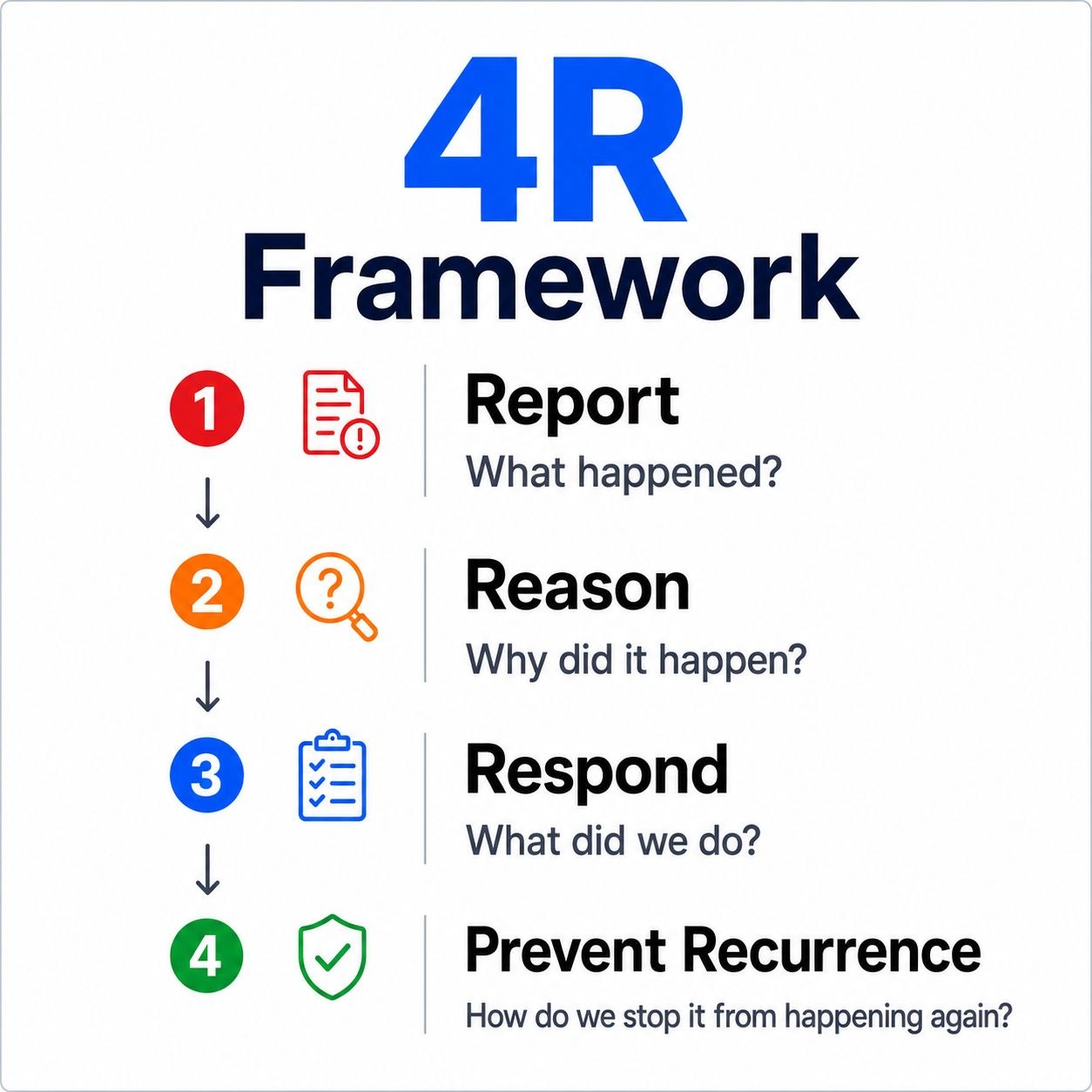
Report: What happened?
- First, record the facts of what happened, objectively
- Write down when, where, and what happened, without speculation
Reason: Why did it happen?
- Dig into the cause behind the facts written in Report
- For a problem you caused, reflect on your own judgment or actions; for a problem that originated from someone else, reflect on the assumptions or systems you were relying on
Respond: How did you respond?
- Record what you actually did while the problem was happening
- Also reflect on whether that response was appropriate, or whether there could have been a better one
Prevent Recurrence: How will you prevent it from happening again?
- Decide what to change going forward, so the same problem doesn’t repeat
- If there’s something that can be turned into a concrete preventive measure, translate it into a specific action here
What recording the 4R gets you
- Keeping the 4R as a single set makes it easy to look back later and see, at a glance, when something happened, what happened, why it happened, how you responded, and what you did for the future
- Keeping a proper log even after the 4R is resolved turns the problem into a reusable lesson, instead of letting it end as a one-off, glossed-over response
- Prevention is hard to fix structurally, but post-incident review can be covered by a habit — the habit of writing the 4R
Summary
- Problems can be organized along two axes: cause (yourself / someone else) and timing (before / during / after)
- People handle the in-the-moment response, but tend to neglect both prevention and post-incident review
- Logging the post-incident review as a 4R (Report / Reason / Respond / Prevent Recurrence) turns problems into lasting lessons instead of letting them get glossed over
References
- TC 25-20: A Leader’s Guide to After-Action Reviews (US Army AAR field manual)